If you are looking at Tanglewood, one of the first surprises is how much two homes can differ even when they sit on seemingly similar streets. In this neighborhood, lot size, section rules, and home style all work together, which can make the market feel more nuanced than it first appears. The good news is that once you understand the patterns, you can evaluate homes with far more confidence. Let’s dive in.
Why Tanglewood Feels So Varied
Tanglewood began development in 1949 and today includes about 1,220 lots across 23 sections. That scale gives the neighborhood a strong identity, but it also creates meaningful variation from one section to another.
The Tanglewood Homes Association notes that deed restrictions are mostly similar across sections, with some minor differences. Those rules can affect setbacks, roof and wall materials, garage orientation, fence placement, driveway entry, and even the direction a residence must face.
That means two properties with the same square footage on paper may not live the same way in real life. The section matters because it shapes how the home sits on the lot and how the outdoor space functions day to day.
Tanglewood Lot Sizes at a Glance
A useful shorthand is that Tanglewood’s median lot size is 15,681 square feet. Houstonia also described the original neighborhood as one-story ranch homes on lots usually around 16,000 square feet, which helps explain why Tanglewood is often seen as large-lot territory for central Houston.
Still, that median only tells part of the story. In practice, lot sizes in Tanglewood can vary widely depending on the section and the specific property.
Smaller Lots Still Exist
You will still find original-era and infill properties on more compact lots. Recent examples include 8,703 square feet in Section 19, 10,761 square feet in Section 17A, and 12,027 square feet in Section 15.
These homes can still offer substantial square footage and luxury finishes. In many cases, the tradeoff is less yard flexibility compared with larger sites elsewhere in the neighborhood.
Mid-Range Lots Are Common
Many buyers will encounter homes in the middle of the range, where lot size still feels generous by Inner Loop standards. Examples include 15,562 square feet in Section 14 and about 18,825 to 19,068 square feet in Section 12.
This range often gives you a balance of house size and outdoor utility. Depending on the build and section rules, you may have room for a meaningful backyard, pool design, or expanded driveway layout.
Larger Estate Lots Stand Out
At the upper end, Tanglewood includes estate-scale and golf-course-adjacent sites. Recent examples include 22,304 square feet in Section 16 and 26,488 square feet in Section 11.
These larger parcels often create a very different ownership experience. More land can allow for greater privacy, a broader building footprint, and more options for outdoor living design.
Why Section Matters as Much as Size
When buyers first compare properties, it is easy to focus on lot square footage alone. In Tanglewood, that can be misleading.
Because deed restrictions can shape setbacks, orientation, garage placement, driveway access, and fence lines, the usable footprint may differ even between two lots of similar size. One lot may feel wider, deeper, or more functional based on how the home is positioned and what the section allows.
This is why a smart comparison usually starts with the section, then the lot, then the house itself. That order gives you a clearer sense of both present livability and future flexibility.
Original Tanglewood Homes
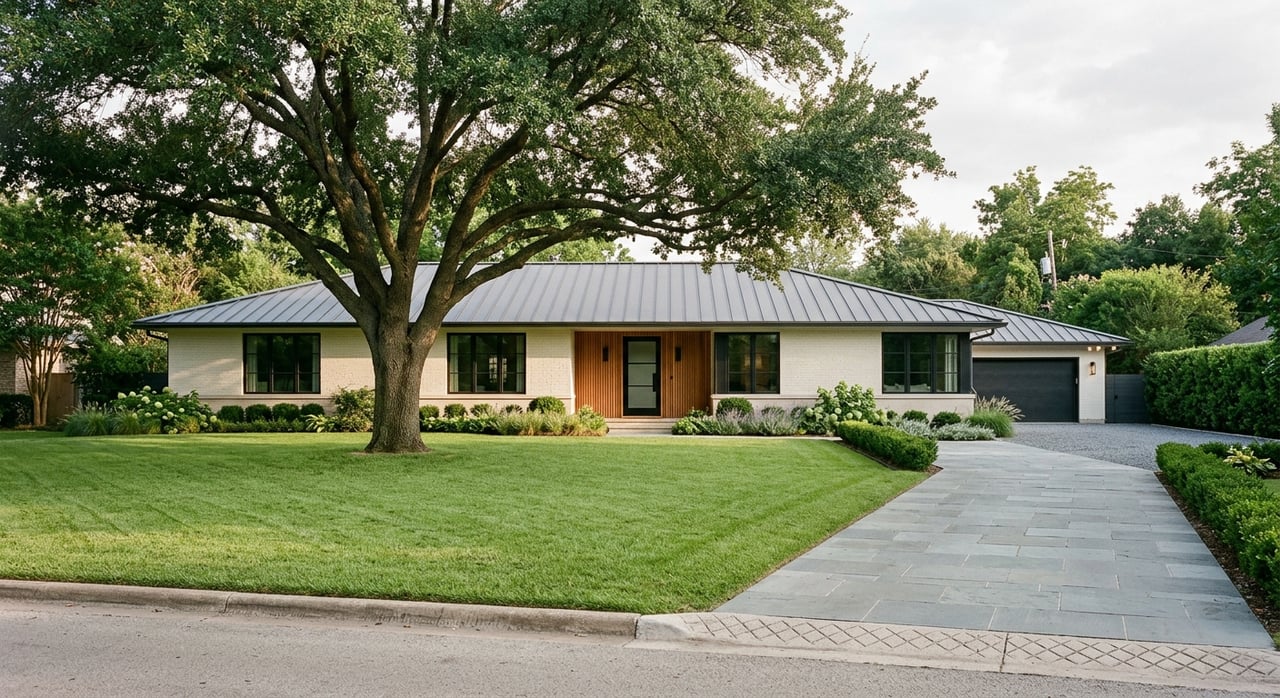
The original Tanglewood housing stock was largely ranch-style, and many of those homes dated from the late 1950s into about 1960. Some mid-century modern and contemporary-modern originals also remain in the mix.
For buyers who appreciate architectural character, these homes can offer appealing proportions, established settings, and mature neighborhood context. Some have been carefully updated, while others may present renovation or rebuild considerations depending on the property.
What Ranch Homes Usually Offer
Original ranch homes in Tanglewood are generally one-story layouts. They often appeal to buyers who value simpler circulation, strong lot presence, and the connection between indoor and outdoor space that many classic ranch plans provide.
In today’s market, a renovated ranch can compete with much newer construction when the lot, finish level, and section all align. Age alone does not determine value here.
Rebuilds and Infill Homes
The Tanglewood Homes Association notes that many original homes have been replaced by larger, updated two-story homes. That shift helps explain the neighborhood’s current architectural mix.
Recent listings show a wide range of styles, including traditional, Georgian, English, and estate-scale custom homes. Construction dates in the neighborhood span from original homes built between 1957 and 1960 to later examples from 1982, 2007, 2008, 2024, and even 2026 construction.
What Newer Homes Tend to Look Like
Infill and rebuild inventory often includes two- and three-story homes with larger footprints and more specialized layouts. You may see formal entertaining spaces, expansive kitchens, additional garage capacity, or more tailored outdoor living features.
These homes can feel very different from the original ranch inventory, even when they are close in lot size. Style, scale, and build quality often shape the experience just as much as land area.
How Lot Size and Style Affect Pricing
Tanglewood pricing is driven by a combination of land, section, age, and build quality. Lot size matters, but it is only one piece of the value equation.
Recent examples show how broad the pricing range can be. A 1982 home on an 8,703-square-foot lot sold in the range of $1.425 million to $1.638 million, while a 2024 build on 10,865 square feet was listed at $3.75 million. A 2026 build on 12,027 square feet was listed at $3.999 million, and a Section 16 lot sale on 22,304 square feet closed in the range of $4.418 million to $5.081 million.
Current neighborhood data also places Tanglewood’s median sale price at about $2.895 million, average price per square foot at about $519, and median year built at 1966. That mix supports what buyers and sellers often see on the ground: older homes, remodeled originals, and new custom builds can all compete within the same neighborhood.
What This Means for Buyers
If you are buying in Tanglewood, it helps to define your priorities before you fall in love with a façade. A smaller lot with a newer custom home may suit you better than a larger parcel with an older layout, or the reverse may be true.
As you compare homes, pay close attention to:
- Section location
- Total lot size
- Home style and age
- Build quality and updates
- How the yard, driveway, and garage actually function
- Whether the lot shape supports your long-term goals
A 10,000- to 12,000-square-foot lot can support a substantial modern home. But if outdoor flexibility is a major priority, a deeper or wider 19,000- to 26,000-square-foot site may offer more options for yard, pool, and driveway design.
What This Means for Sellers
If you own a home in Tanglewood, your property should be positioned based on more than square footage alone. Buyers in this market are often comparing the full package: section, lot usability, architecture, age, updates, and presentation.
That is especially important in a neighborhood where an original ranch, a renovated mid-century home, and a newly built Georgian-style residence may all appeal to different buyers. The strongest pricing strategy highlights how your specific property fits into the broader Tanglewood landscape.
For some sellers, the value story may center on land and future potential. For others, it may be the quality of a recent rebuild, the character of an original home, or the livability created by the lot’s orientation and layout.
A Simple Way to Evaluate Tanglewood Homes
If you want a clear framework, start with three questions:
- Which section is the home in?
- How usable is the lot beyond its raw square footage?
- Does the home’s style and age match your goals?
That approach can help you quickly separate a good fit from a great fit. In Tanglewood, the best property for you is not always the one with the biggest lot or the newest construction. It is the one where land, restrictions, design, and daily function come together in the right way.
If you are weighing a purchase, planning a sale, or trying to understand how your home fits into the current Tanglewood market, working with a local luxury advisor can make the comparison process much more precise. For discreet guidance and a tailored strategy, connect with JD Adamson.
FAQs
What is the typical lot size in Tanglewood, Houston?
- Tanglewood’s median lot size is 15,681 square feet, and original homes were often built on lots around 16,000 square feet, though actual lot sizes vary widely by section.
Do Tanglewood lot sizes vary by section?
- Yes. Recent examples range from about 8,703 square feet in Section 19 to 26,488 square feet in Section 11, which is why section-level comparison matters.
What home styles are common in Tanglewood?
- You will find original ranch-style homes, some mid-century modern or contemporary-modern homes, and many newer traditional, Georgian, English, and custom estate-style rebuilds.
Are most Tanglewood homes original or newly built?
- The neighborhood includes both. Some homes date to the late 1950s and early 1960s, while many original homes have been replaced by larger two-story and custom newer construction.
Does lot size alone determine home value in Tanglewood?
- No. Pricing is influenced by land, section, age, build quality, and how deed restrictions affect livability and future building flexibility.
Why do deed restrictions matter in Tanglewood real estate?
- Tanglewood deed restrictions can affect setbacks, materials, garage orientation, fence placement, driveway entry, and home orientation, which can change how a lot functions even when the square footage is similar.