Say you put a teardown-ready lot in Afton Oaks under contract, waive your option period on schedule, and then find out two weeks later that your renovation plans need sign-off from a committee you didn't know existed before the city will even look at your permit application. That is not a hypothetical inconvenience. It is how the neighborhood's own governing paperwork is built, and it is the detail that trips up buyers and sellers who treat Afton Oaks as one uniform product rather than what it actually is.
Afton Oaks markets as a single, tidy name on a map. Underneath that name are two different real estate products sharing the same streets, and a deed restriction system that changes depending on which lot you happen to be standing on. Neither the price you'll pay nor the paperwork you'll need generalizes from one address to the next. That is the thing worth understanding before you write a number into a contract here.
A Neighborhood Selling Two Different Things
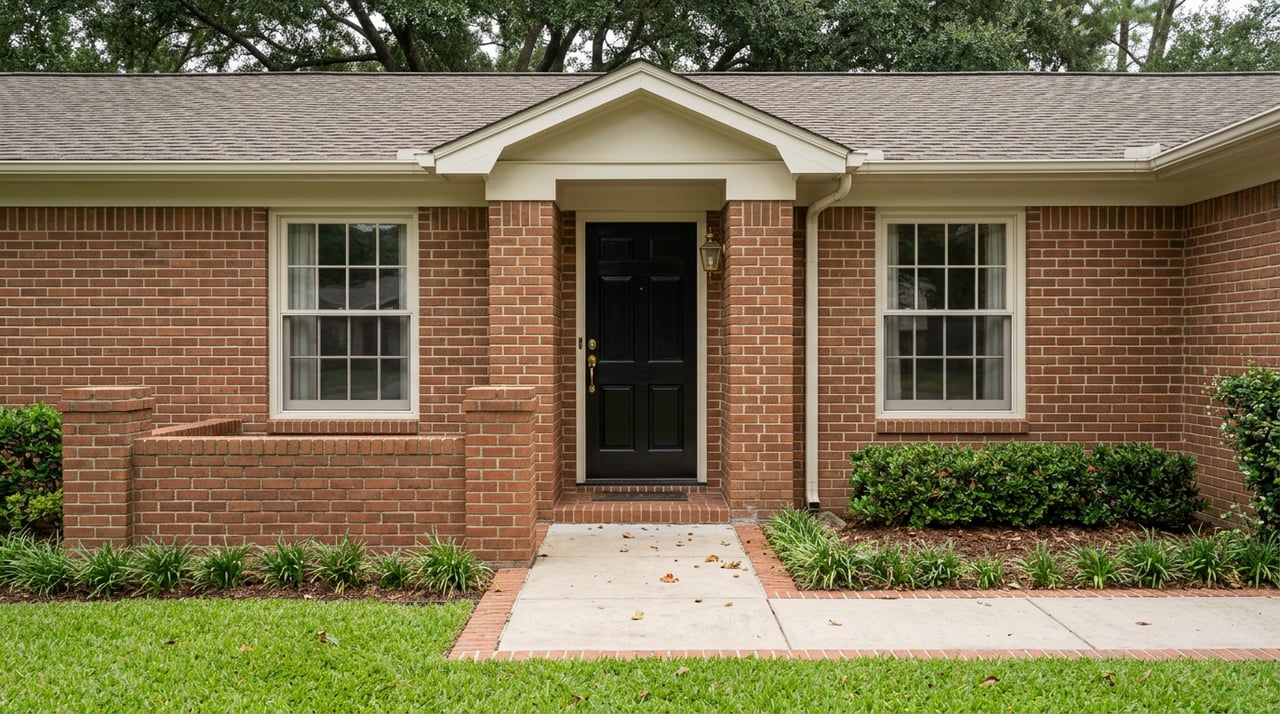
Afton Oaks was built out in stages between 1951 and 1959 as brick ranch homes on generous lots, and for decades that is what the neighborhood was. As land values in the Inner Loop climbed, that started to change. New construction has replaced a growing share of the original ranch stock, and because of where the land sits, those new builds typically start well above a million dollars.
The two products now sit side by side. This summer, a 1956-built ranch home on a 6,900-square-foot lot went under contract in the high $600,000s, the kind of price that signals a renovation or rebuild candidate more than a finished move-in home. In the same weeks, a newly built home on a comparably sized 8,400-square-foot lot listed near $2.2 million. Same neighborhood, same rough lot dimensions, a $1.5 million gap between them.
As Realtor Moises Arteaga has described the shift, the brick ranch originals that used to define Afton Oaks are now the exception, and larger, newer construction is what fills most of the neighborhood today. Builders active in the area right now include Partners in Building, which has spec and build-on-your-lot projects underway, and Everlasting Homes Building Group, which is using ICC-certified structural concrete insulated panel construction on at least one current build, a materially different approach than the wood-frame ranch homes it's replacing. Owners who want to update rather than rebuild have also turned to firms like Brickmoon Design, which works specifically within the neighborhood's older housing stock.
That is not a footnote. It means any comparable you pull for pricing purposes has to be sorted by product type first, ranch resale or new construction, before it's useful at all.
The Median Everyone Quotes Is Measuring a Moving Target
Here is where the two-product reality shows up in the numbers, and it shows up as outright disagreement between sources covering the same period.
One widely used listing site's data for the three months ending April 2026 puts Afton Oaks' median sale price at $997,000, a 49.8 percent decline from the same period a year earlier, with the median price per square foot down 27.5 percent and homes taking a median of 62 days to sell compared with 33 days the year before. Only 11 homes sold in April 2026, down from 15 the year prior.
Over roughly the same stretch, a single national listing site's own sub-pages couldn't agree with each other. One page put the median at $1,050,000 as of December 2025. Another showed $985,000, up 4 percent year over year. A third showed $995,000, also up 4 percent. A fourth showed $1,030,000, down 17 percent.
Read those side by side and the range runs from a nearly 50 percent decline to a modest gain, all supposedly describing the same neighborhood in the same general window. That kind of spread doesn't happen in markets with deep, consistent inventory. It happens when the sample size is small and the mix keeps shifting, a run of $600,000-to-$700,000 ranch resales one stretch, a run of $2 million-plus new builds the next, each one swinging a thin median by six figures. For comparison, Houston's broader single-family market moved far less over a similar window, with the median sale price through HAR's MLS data sitting at roughly $331,692 for the 12 months ending in May 2026, down just 1.2 percent from the year before.
If you're selling a ranch lot, the neighborhood median tells you almost nothing useful about your price. If you're pricing a finished new-construction home, the same is true in the other direction. The number that matters is the one from your own product segment, not the blended average of two segments that don't behave alike.
Why the Same Restriction Doesn't Travel Next Door
The pricing split has a legal counterpart, and it's less well understood. Afton Oaks has carried deed restrictions since its earliest development in the 1950s, and by the Civic Club's own account, those restrictions are specific to the section and lot, not uniform across the neighborhood. A restriction that governs one street's setbacks, height limits, or use provisions may not be the restriction that governs the lot two blocks over. Current listings still reference this directly, with individual homes tied to specific numbered sections of the original plat.
The Civic Club has appointed an Architectural Review Committee whose job is to confirm that any exterior addition, renovation, or new construction complies with whichever restrictions apply to that specific property. That review isn't a courtesy step. The City of Houston requires certification of deed restriction compliance before it will issue a building permit, which means plans need to go to the committee before they go to the city, not after.
Civic Club board member Mark Worscheh has framed the committee's role as one of managing pressure from all sides, noting that as development continues around the neighborhood, the club works to maintain the neighborhood's residential character and its greenery. That balancing act is exactly why the review exists, and exactly why it can't be skipped or assumed based on what a neighbor built.
The Approval Order That Belongs in Your Contract Timeline
None of this is disqualifying. It's sequencing, and sequencing is manageable if you plan for it instead of discovering it midway through a contract.
Before removing a deed restriction or feasibility contingency on a teardown or new-build lot in Afton Oaks, it's worth confirming:
- Which section and set of restrictions actually apply to that specific lot, not the neighborhood in general
- Whether the Architectural Review Committee has received preliminary plans, since submission is expected before permitting, not concurrent with it
- How much calendar time the committee typically needs to review, so that window is built into the option period rather than layered on top of it
- Whether your builder or architect has worked through this specific committee before, since familiarity with its review cadence is worth more than familiarity with Houston permitting in general
What This Looks Like From Each Side of the Table
For a seller sitting on a ranch-era lot, the practical move is pricing against comparable teardown-candidate sales in the same product tier, not the blended neighborhood median, and having the section-specific restriction documentation ready to hand a buyer rather than making them chase it down during due diligence. A buyer who can see the applicable restrictions on day one moves faster and with more confidence, which shows up in your net price.
For a buyer planning to build new, the move is the reverse: build the Architectural Review Committee's timeline into your contract from the start, and treat a builder's prior experience with that specific committee as a real asset, not a nice-to-have. A design that would sail through review with one architect can generate rounds of revisions with another simply because they don't know what this particular committee tends to flag.
Either way, the lesson is the same. Nothing about Afton Oaks generalizes cleanly from one address to the next, not the price and not the paperwork. Both require verification at the lot level before they belong in a contract.
A Few Direct Questions
Do all deed restrictions in Afton Oaks say the same thing? No. They're specific to the section and lot, which is why the Civic Club recommends confirming with a professional advisor exactly which restrictions apply to a given property rather than assuming based on a neighboring home.
Does a renovation need Architectural Review Committee approval, or only a full rebuild? Both. The committee's mandate covers exterior additions and renovations as well as new construction.
What if I can't locate the restriction paperwork for my specific lot? That's a question for the Civic Club directly, since the amended restrictions are organized by section and aren't always the same document a neighboring owner has on file.
If you're weighing a teardown-candidate purchase, a new build, or a sale of either in Afton Oaks, I'd rather walk you through the specific section and committee history for your lot before you're under contract than after. That's the difference between a clean timeline and a stalled one.
JD Adamson offers a confidential consultation and complimentary home valuation for sellers and buyers evaluating property in Afton Oaks. Reach out to start with the specifics of your lot, not the neighborhood average.